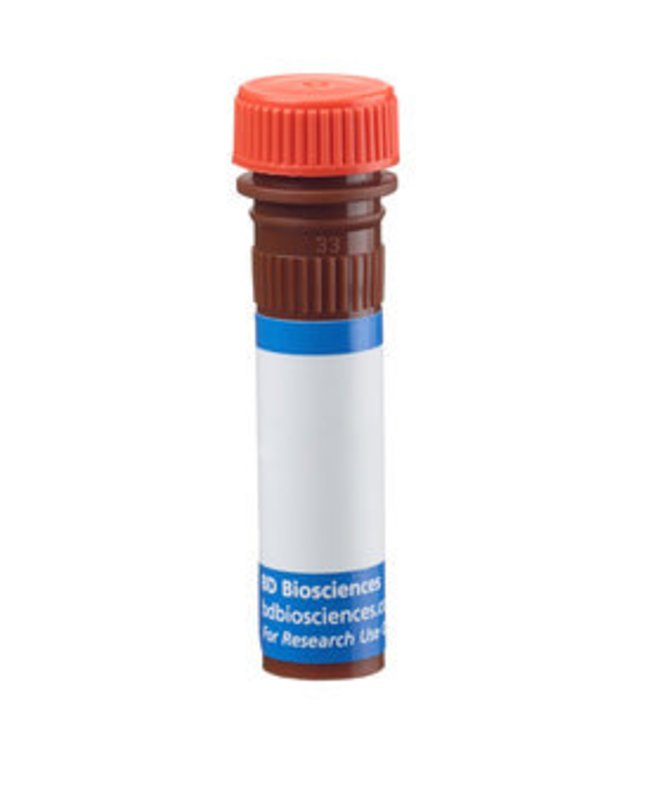
Cd8 Mouse Anti-Human, Pe-Cf594, Clone: Rpa-T8, Bd, Mouse Monoclonal Antibody, Each
|
|
Details
The rpa-t8 monoclonal antibody specifically binds to cd8 alpha (cd8α) . Cd8α is a type i transmembrane glycoprotein and a member of the immunoglobulin superfamily. Cd8α is expressed by the majority of thymocytes, by subpopulations of αβ t cells and γδ t cells and by some nk cells. Cell surface cd8α is expressed either as a disulfide-linked homodimer (cd8αα) αβ t cells coexpress both cd8αα homodimers and cd8αβ heterodimers whereas some γδ t cells and nk cells express cd8αα homodimers. Cd8 plays important roles in t cell activation and selection. The extracellular igsf domain of cd8 α binds to a non-polymorphic determinant on hla class i molecules (α3 domain) and enables cd8 to function as a co-receptor with mhc class i-restricted tcr during t cell recognition of antigen. The cytoplasmic domain of cd8α associates with lck, a src family protein tyrosine kinase that is involved in intracellular signaling. The rpa-t8 and hit8a monoclonal antibodies are not cross-blocking. This clone has been reported to react with a subset of peripheral blood lymphocytes, but not monocytes nor granuloyctes, of baboon and both rhesus and cynomolgus macaque monkey. In general, a higher frequency of cd8+ and cd4+cd8+ lymphocytes are observed in non-human primates compared to normal human donors. This antibody is conjugated to bd horizon pe-cf594, which has been developed exclusively by bd biosciences as a better alternative to pe-texas red™. Pe-cf594 excites and emits at similar wavelengths to pe-texas red™ yet exhibits improved brightness and spectral characteristics. Due to pe having maximal absorption peaks at 496nm and 564nm, pe-cf594 can be excited by the blue (488-nm), green (532-nm) and yellow-green (561-nm) lasers and can be detected with the same filter set as pe-texas red™ (eg, 610/20-nm filter).
Additional Information
| SKU | 10134333 |
|---|---|
| UOM | Each |
| UNSPSC | 12352203 |
| Manufacturer Part Number | 562282 |
