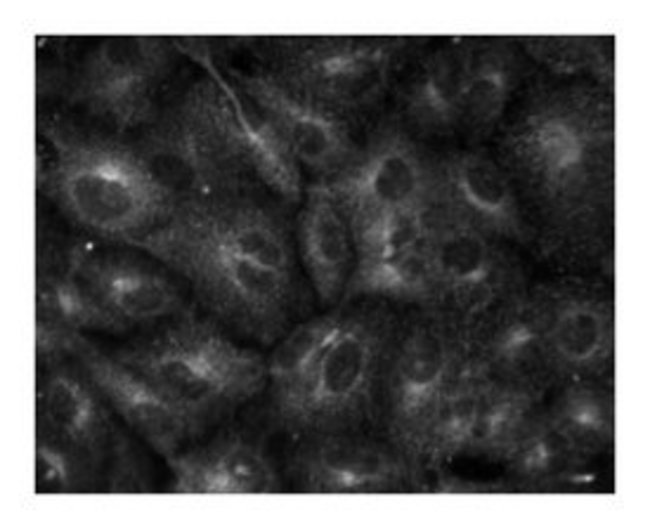
Pi4-Kinase Β Mouse, Unlabeled, Clone: 7, Bd, Mouse Monoclonal Antibody, Each
|
|
Details
Phosphoinositide turnover is a well established mechanism of intracellular signal transduction. Sequential phosphorylation of phosphatidylinositol (ptdins) results inptdins-4-phosphate (pip) and ptdins-4,5-bisphosphate (pip2). Phospholipase c (plc)hydrolyzes pip2 to inositol-1,4,5-trisphosphate (ip3) which stimulates release of intracellular ca2+. Pip is generated by phosphorylation of ptdins at the d4 position of the inositol ring. This event is mediated by the ptdins 4-kinases (pi4-k). These enzymes are divided into two types (ii and iii) based on their size and sensitivity to certain compounds. Although the pi4-ks are abundantly distributed throughout the cell, activity is found primarily in association with membranous structures. Members of this family contain a lipid kinase unique domain and a c-terminal catalytic domain. Two mammalian pi4-ks, pi4-kα and pi4-kβ, have been identified. Pi4-kβ is homologous to the yeast pi4-k, pik1. Based on its size and sensitivity to wortmanin (a pi3-k inhibitor), pi4-kβ is classified as a type iii enzyme. Although it is found in the cytosol and in association with the golgi, the specific function of pi4-kβ is yet to be determined.Host species: mouseclone: 7isotype: igg1species reactivity [for features main]: humanimmunogen: human pi4kβ aa. 411-626Immunofluorescence, western blotting
Additional Information
| SKU | 10135446 |
|---|---|
| UOM | Each |
| UNSPSC | 12352203 |
| Manufacturer Part Number | 611817 |
